
 CONTACT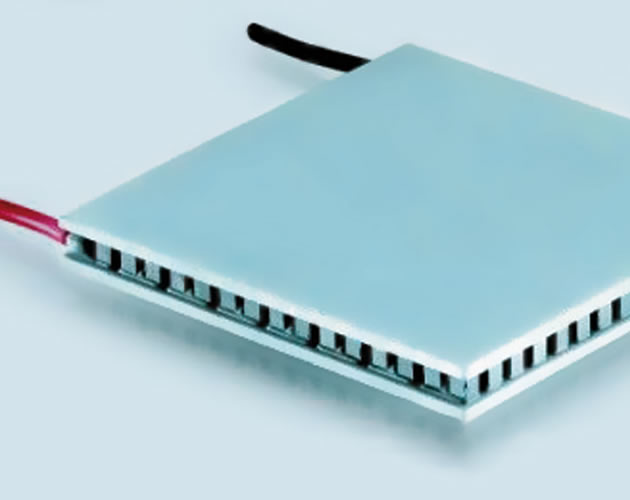
Efficient Thermal Management with Peltier Elements
Peltier elements are powerful thermoelectric components that play a significant role in the world of thermal management. They enable both effective cooling and heating of components.
Peltier elements
Peltier elements are based on the Peltier effect, a physical principle in which temperature differences are generated when an electric current flows through two different semiconductor materials. These temperature differences are used to transfer heat from one area to another. Therefore, Peltier elements can both cool and heat, depending on the direction of the current. Special applications include TEC assemblies for PCR cyclers in medical technology, temperature controllers, processor coolers or heaters in coffee machines. Peltier elements are often used in combination with heat pipe assemblies. The combination with Peltier elements allows precise control of cooling and heating processes.
For optimized heat flow, various thermal interface materials (TIM) can be used. These include thermal conductive pastes (TCP) and phase change materials (PCM). PCMs wet the surfaces and change their aggregate state with increasing temperatures and provide effective heat dissipation.
HALA YOUR SPECIALIST
HALA specializes in thermal interface material (TIM) design-in and customized solutions. We believe that efficient thermal management further drives not only performance, but also sustainability of applications.
Further TIM solutions for thermo-electric modules: thermally conductive silicone foils for electrically insulating flat interfaces, graphite foils for lateral heat spreading on the hot side and thermally conductive adhesives for permanent bondline applications.
Contact us to find out how we can improve your thermal management.
FAQ
Peltier elements are thermoelectric components based on the Peltier effect — a physical principle in which temperature differences are generated when an electric current flows through two different semiconductor materials. Depending on the direction of the current, Peltier elements can both cool and heat. They are used in TEC assemblies for PCR cyclers in medical technology, temperature controllers, processor coolers and precision heating applications such as coffee machines. They are often combined with heat pipe assemblies for more effective heat removal.
Peltier elements pump heat from the cold side to the hot side. Any thermal resistance at the TIM interfaces — both on the cold side (object being cooled) and the hot side (heat sink) — directly reduces the temperature differential achievable and the overall COP (coefficient of performance). Minimising thermal resistance at both interfaces through optimal TIM selection is therefore essential for efficiency and precise temperature control.
Phase change materials are the preferred TIM for Peltier elements — they deliver the lowest thermal resistance at both the cold and hot side interfaces with process-safe pre-assembly. Thermally conductive grease is used for reworkable installations. Graphite foils spread heat laterally on the hot side heat sink. For permanent bonding, thermally conductive adhesives eliminate the need for mechanical fasteners.
Peltier elements are frequently used in combination with heat pipe assemblies. The heat pipe transports the heat dissipated from the hot side of the Peltier element to a remote heat sink, enabling compact designs where a large heat sink directly adjacent to the Peltier element is not feasible. This combination allows precise control of cooling and heating processes in space-constrained applications.
Yes. HALA specialises in TIM design-in for specific thermo-electric module applications — from material selection through prototype sampling to series supply of custom die-cut parts. Contact HALA’s experts for a free consultation and sample.